
Lead-free ammunition: do you still need a mask at the range?

Lead-free ammunition removes the largest single source of lead fume at the muzzle, and that is a real gain. It does not remove primer vapors, metal dust, or the lead other shooters have already left in the room. So yes, you still need a mask on the firing line, and here is why.
Key takeaways
- Lead-free ammunition changes the projectile, not the air. The round still produces vapor and dust.
- Lead-free primers are not inert. Many still use barium and antimony compounds, which vaporize the moment the pin falls.
- Your ammo does not clean the room. Lead from other shooters is still on the surfaces and in the air.
- Ventilation moves air across the range. It does not filter the air in your breathing zone.
- The practical answer is to do both: shoot lead-free where you can, and keep the respirator and the hygiene routine.
What "lead-free" actually covers
Lead-free is a broad label. It covers solid copper bullets, copper-polymer composites (common in frangible training and range loads), steel and bismuth shot, and tungsten in premium loads. What they share is the absence of a lead core, not the absence of emissions.
None of these metals vaporize the way lead does under firing heat. That is the core health gain.
The primer is the other half of the round
Conventional primers rely on lead styphnate as the primary explosive. Lead-free primers typically swap in DDNP (diazodinitrophenol), but many still use barium nitrate as the oxidizer and antimony sulfide as the fuel.
So a round can be truly lead-free and still release barium, antimony, nitrogen oxides and carbon monoxide every time the pin falls. Lead-free does not mean gas-free. It means less lead. When you read the box, check the primer as well as the bullet.
What a lead-free round still sheds
Lead-free bullets are not fragment-free bullets. That matters at the firing line, where every impact throws material into the air you are breathing.
A purpose-designed monolithic copper bullet expands and tends to retain most of its mass. In standardized terminal ballistics testing, a deforming lead bullet produced many more fragments than a deforming copper bullet (Performance of Lead-Free versus Lead-Based Hunting Ammunition).
Fewer fragments is not zero fragments. Copper still spalls, jackets still scrape the bore, and backstops still throw dust on every impact.
| What changes | Lead ammunition | Lead-free ammunition | What it means for you |
|---|---|---|---|
| Muzzle fume | Lead vaporizes at firing temperature | Largely removed from the projectile | The biggest single health gain of switching |
| Primer | Lead styphnate | Often DDNP with barium and antimony | You cut lead, not all metal vapor |
| Fragmentation | Lead fragments widely | Copper holds together; bismuth and steel can still shed and spall | Fewer fragments, not fragment-free |
| Airborne dust | Lead-bearing dust | Copper and steel dust, still respirable | Protection matters either way |
What is still in the air at the firing line
Your ammunition is one input. The room is another.
A NIOSH Health Hazard Evaluation of an indoor police range measured personal breathing-zone samples of 132 to 254 µg/m³ across a single 70-minute training exercise. NIOSH estimated the equivalent 8-hour time-weighted averages at 20 to 38 µg/m³, and still concluded a hazard existed, because the ventilation was not clearing lead from the range air effectively. For context, the OSHA permissible exposure limit is 50 µg/m³ as an 8-hour average, with an action level of 30 µg/m³ (29 CFR 1910.1025).
It shows up in blood, too. A 2017 review in Environmental Health pooled 36 studies of range users. In 31 of them, some shooters had blood lead levels above 10 µg/dL, and 18 studies reported levels above 20 µg/dL. The authors singled out recreational shooters, including women and children, because they never receive workplace protections (Laidlaw et al., 2017).
For reference, the blood lead reference value cited by CDC/NIOSH is 3.5 µg/dL, which is a screening benchmark, not a safety threshold (CDC/NIOSH). To learn when and how to get tested, read our guide to blood lead level testing for shooters, and talk to your doctor about your own results.
Why ventilation does not clear your breathing zone
Range ventilation is designed to move air across the room and out. It is not personal protective equipment, and it cannot put a clean-air envelope around your head during active firing.
- Peak exposure happens during firing, in your breathing zone.
- Ducting, filter condition and airflow direction all change what reaches you.
- A "compliant" range can still exceed limits at the firing line.
Replacing lead components is the highest-leverage reduction available. It is also incomplete. For the full picture, see what is in the air at an indoor range.
What else changes when you switch
- Recoil. It depends on bullet weight, velocity, powder charge and firearm weight, not on the bullet metal alone. Copper loads are often lighter and faster, so compare published load data.
- Barrel care. Monolithic copper bullets are harder than a lead core and can put more stress on the throat in some rifles. Clean on your normal schedule and watch accuracy.
- Cost. Copper hunting loads carry a premium. Budget for it, or reload.
- Ricochet. Steel rebounds harder off hard surfaces. Use only ammunition the range permits with its approved backstop, and stop firing and alert staff if you hear or see a ricochet.
So do you still need a mask?
Yes, and a lead-free round does not change that. Switching bullets leaves behind:
- Primer vapors: barium, antimony, nitrogen oxides, carbon monoxide.
- Fine copper and steel dust thrown off by friction and impact.
- Lead that is already in the environment, from other shooters, on surfaces and suspended in the air.
None of that is filtered by choosing a different bullet, and all of it sits in your breathing zone. Particulate from firearms is a documented inhalation concern, not a theoretical one (PM chemistry and lung toxicity).
What a respirator adds
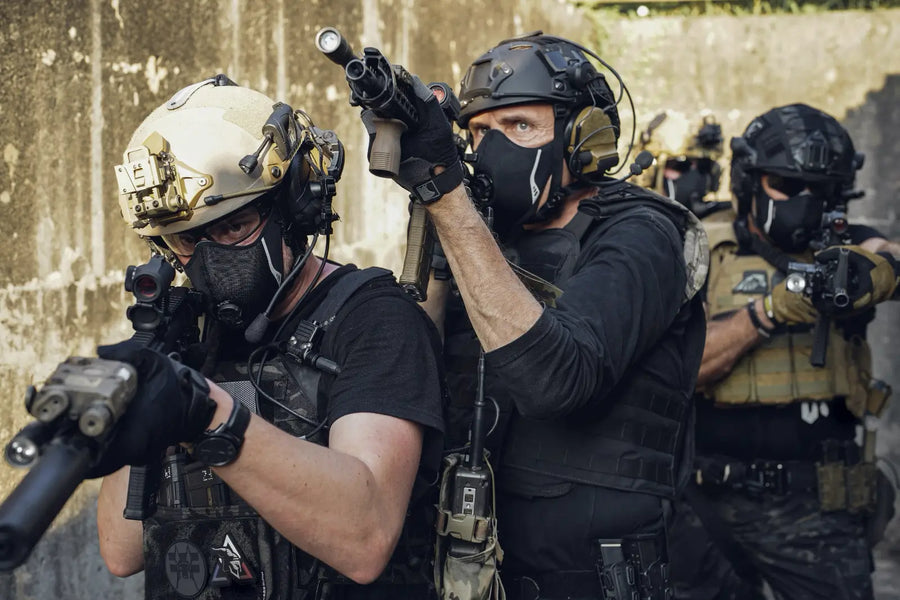
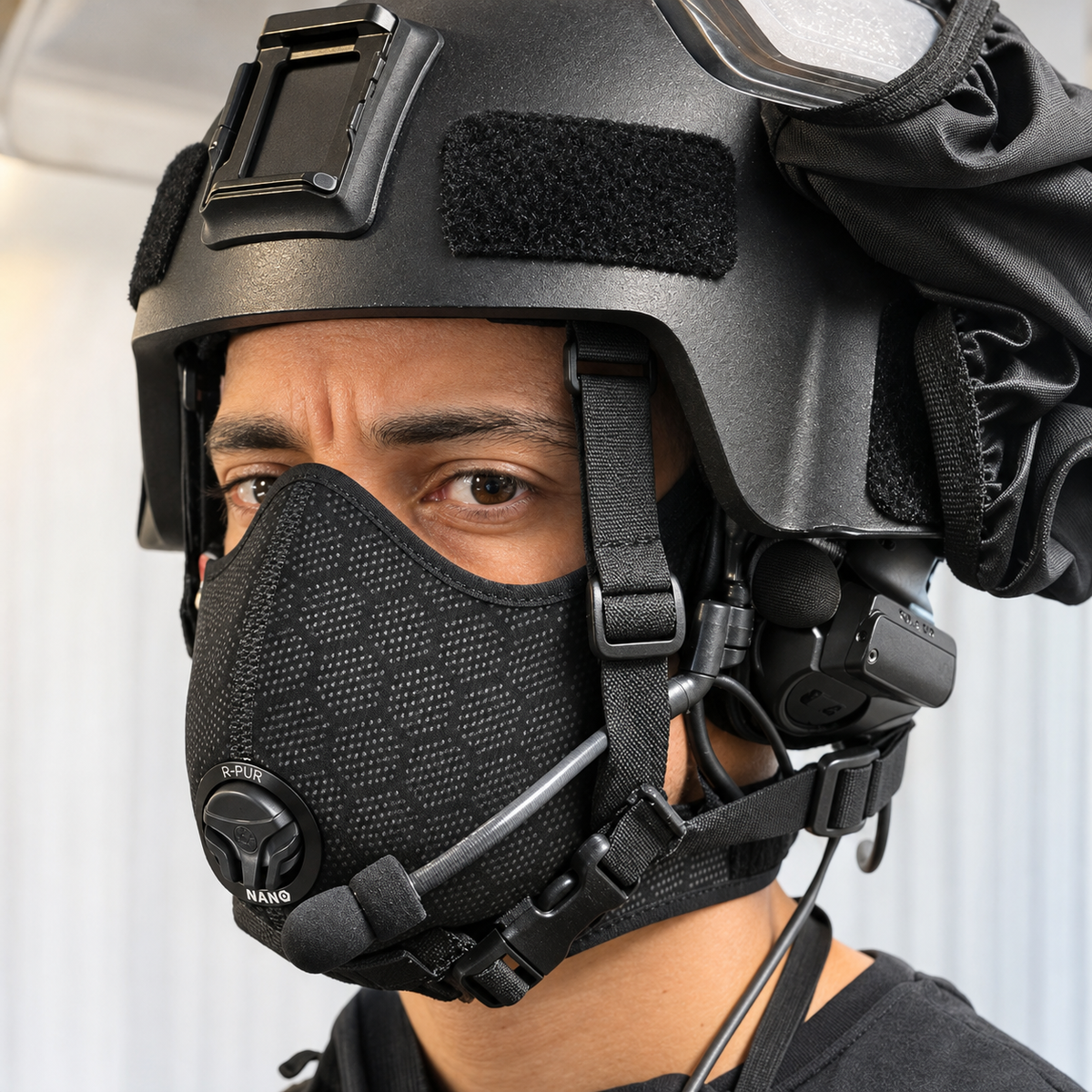
A respirator is the only control that filters the air where you actually breathe. A P100 half mask does that. Another option is the NANO® Range Mask, which filters particles down to 50 nanometers (PM0.05) with internationally patented nanofiltration and has an activated carbon layer that reduces gunpowder gases and odors. Whatever you pick, wear it with your hearing protection on and check the seal, because fit matters more than the label. Our guide to choosing a respirator for the range compares the options.
A mask reduces what you breathe in. It does not replace range ventilation, and if you work at a range, it does not replace your employer's respiratory protection program.
The rest is hygiene
- Mask on before you enter. Contamination starts at the door.
- No eating, drinking or face-touching on the line. Hand-to-mouth is a primary exposure route, and it bypasses your respirator entirely.
- Wash your hands and face with cold water as soon as you leave the line.
- Change out of range clothes before you get in the car, and wash them in a separate load.
- Wipe down your firearm, bag and ear protection with a damp cloth. The decontamination protocol walks through every step.
- Ask your doctor about tracking your blood lead level if you shoot regularly.
FAQ
Is lead-free ammunition completely safe to breathe around?
No. Lead-free projectiles significantly reduce your exposure to lead fume, but they do not eliminate every risk in range air. Lead-free primers may still contain barium or antimony, propellant combustion releases nitrogen oxides and other irritants, and friction between copper or steel and the bore produces microscopic metal dust.
Are the metals in lead-free ammunition toxic?
Copper and bismuth are considered significantly less toxic than lead, and they vaporize far less readily under firing heat. "Non-toxic" does not mean biologically inert, though. Microscopic copper or steel dust is still an irritant to the airways, so the hygiene routine still applies.
Is there a lead ammunition ban in the United States?
There is no single nationwide ban. California has required certified non-lead ammunition for taking wildlife statewide since July 1, 2019 (Fish and Game Code § 3004.5), several other states restrict lead on specific lands or species, and a 2022 U.S. Fish and Wildlife Service rule added non-lead requirements refuge by refuge instead of system-wide. Check your state wildlife agency and your range's own rules before you shoot.
If you want a reusable mask with replaceable filters for the particles and gases a lead-free round still leaves in the air, take a look at the Nano Range.
Sources
- NIOSH Health Hazard Evaluation HETA 90-0168-2248, indoor police range
- OSHA 29 CFR 1910.1025, Lead
- CDC/NIOSH: blood lead level reference value
- Laidlaw et al., "Lead exposure at firing ranges: a review", Environmental Health, 2017
- Performance of Lead-Free versus Lead-Based Hunting Ammunition
- Chemistry and lung toxicity of particulate matter emitted from firearms
- California Fish and Game Code § 3004.5
- USFWS 2022 to 2023 Station-Specific Hunting and Sport Fishing Regulations
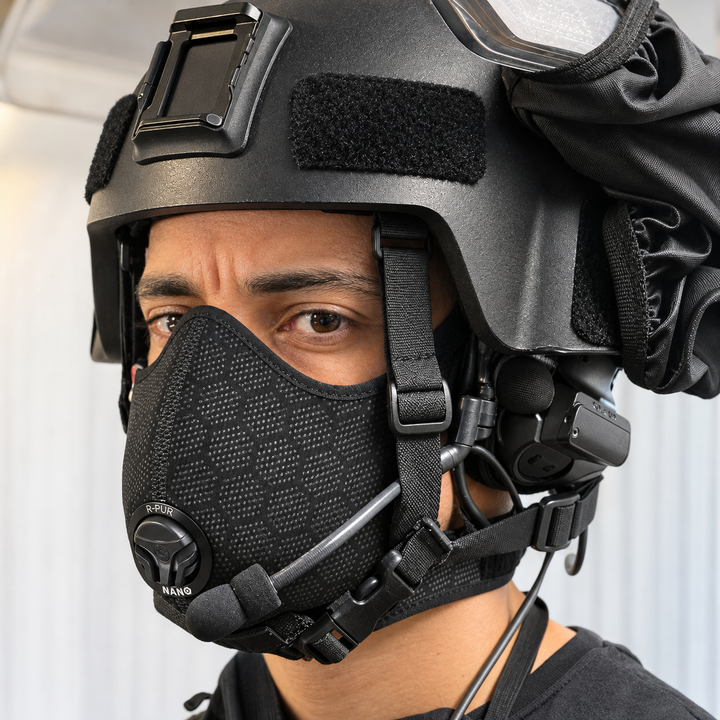
NANO® Range Mask
The shooting mask that filters particles down to 50 nanometers.
From $179 $199
This article is general information for shooters, not medical advice. If you think you have been exposed to lead, talk to your doctor.
Keep reading


Built for the firing line
NANO® Range Mask
Filters particles down to 50 nanometers, with an activated carbon layer for gunpowder gases and replaceable filters.
From $179 $199
