
Indoor shooting range air quality: what you are breathing

Every shot fired at an indoor range puts lead dust, combustion gases and ultrafine particles into the air at the same time. Good ventilation pushes that mix away from the firing line, but it does not remove all of it, or the lead already settled in the room. Here is what you are breathing, what repeated exposure does, and what actually reduces it.
Key takeaways
- Lead is the main hazard, and it comes from the primer as well as the bullet.
- OSHA's permissible exposure limit for airborne lead is 50 µg/m³ over an 8-hour shift. Airborne lead can exceed that level during active firing and bullet trap cleaning.
- Ventilation reduces exposure. It does not eliminate it.
- For a respirator, P100 or N100/FFP3 class filtration is the minimum. Surgical, cloth and basic dust masks do not do the job.
- No single measure is enough. Stack ventilation, a respirator and clean habits.
What is in the air at an indoor range
Lead from the bullet and the primer
Lead is the primary hazard at any indoor range, and it gets into the air two ways. One is the bullet itself, especially unjacketed or semi-jacketed lead projectiles. The other is the primer: it contains lead styphnate, which vaporizes on ignition and condenses into sub-micron particles that get past the nose and throat and deposit deep in the lungs.
For scale, OSHA sets an action level of 30 µg/m³ for airborne lead and a permissible exposure limit (PEL) of 50 µg/m³ over an 8-hour shift. During active firing, concentrations in the shooter's breathing zone can exceed both. During bullet trap cleaning, NIOSH investigators have measured short-term levels of 54 to 64 µg/m³.
Range lead does not stay in the air. It settles on surfaces, clothing, skin and hair, and it gets resuspended every time someone walks through the lane.
Combustion gases
Burning propellant releases carbon monoxide (from incomplete combustion), nitrogen oxides, which irritate the airways and can trigger or worsen asthma with repeated exposure, and volatile organic compounds, including polycyclic aromatic hydrocarbons (PAHs), which are known carcinogens. None of these show up on a particle counter, and they build up fast in an enclosed space with limited air exchange.
Fine and ultrafine particles
Firearms produce a wide spread of particle sizes, and the dangerous fraction is at the small end.
| Particle type | Size | Where it deposits |
|---|---|---|
| PM10 (coarse) | Under 10 microns | Upper airways |
| PM2.5 (fine) | Under 2.5 microns | Deep lung tissue |
| PM0.1 (ultrafine) | Under 0.1 micron (100 nanometers) | Alveoli, bloodstream |
| PM0.05 (nanoscale) | Under 0.05 micron (50 nanometers) | Systemic circulation |
One study of firearm emissions measured PM2.5 at 14.9 mg per shot for a pistol and 38.0 mg per shot at the muzzle of an M4 rifle. Particle counts during active firing at indoor ranges have been recorded as high as 758,000 particles per cubic centimeter, dominated by particles below 100 nanometers. Those particles carry metals: lead, copper and antimony.
How ventilation changes what you breathe
Ventilation is the first line of defense. A properly designed range delivers laminar airflow from the shooter toward the target, pushing contaminants away from the breathing zone. HEPA filtration on the return air is essential. Without it, the system just recirculates contaminated air.
Even a well-designed system has limits:
- It does not remove lead already settled on surfaces.
- Airflow patterns get disrupted by lane dividers, shooters moving and doors opening.
- You have no control over a range's HVAC when you walk in.
What you can do is choose ranges with documented, well-maintained ventilation, and ask when the system was last inspected. If you are an RSO or help maintain a range, never dry sweep or dry dust. Use wet methods or a HEPA vacuum.
What repeated exposure does
There is no safe blood lead level. A 2017 systematic review of 36 studies on shooting range lead exposure found that nearly all measured blood lead levels in shooters exceeded 5 µg/dL. In 31 of those studies, shooters were above 10 µg/dL, and in 17 they were above 30 µg/dL. Many were recreational shooters.
Short term, symptoms linked to lead exposure include headaches, fatigue and trouble concentrating, nausea and abdominal cramping, irritability and mood changes, and elevated blood pressure. They are easy to write off as a long day or dehydration. If they keep showing up after range sessions, talk to your doctor. Our guide to the symptoms of lead poisoning in shooters goes into more detail.
Long term, lead accumulates in bone and soft tissue and does not flush out quickly. Chronic exposure, even below occupational levels, is linked to:
- Cognitive decline and memory impairment
- Peripheral neuropathy (nerve damage that causes weakness or numbness)
- Kidney damage
- Cardiovascular disease, including hypertension
- Reproductive harm, including reduced sperm quality in men and pregnancy complications in women
There is also take-home contamination: lead on your clothes and skin can expose your family, and children are far more vulnerable than adults. If you shoot monthly or more, ask your doctor about a blood lead level test.
Does lead-free ammunition fix it?
It helps, and it does not finish the job. Studies show that switching to lead-free projectiles can cut breathing-zone lead from a range of 0.077 to 0.13 mg/m³ down to 0.006 to 0.022 mg/m³. That is a real reduction, but it is not zero.
Many loads sold as "lead-free" still use a conventional lead styphnate primer, which puts lead in the air before the propellant even burns. A fully lead-free load needs a lead-free primer too, sometimes labeled "non-toxic" or "NT" primer. Even then, the room still holds lead dust from thousands of earlier rounds. We cover the detail in lead-free ammunition: do you still need a mask.
What actually reduces your exposure
A respirator that matches the hazard
Respiratory protection is the second layer, and the one you control. The minimum is a P100 respirator, the US class rated to filter at least 99.97% of airborne particles, or the N100/FFP3 level. Range air also carries combustion gases, which a particle filter alone does not address, so look for an activated carbon layer as well. Then check the seal: air leaking around the edges is the biggest failure point of disposable masks.
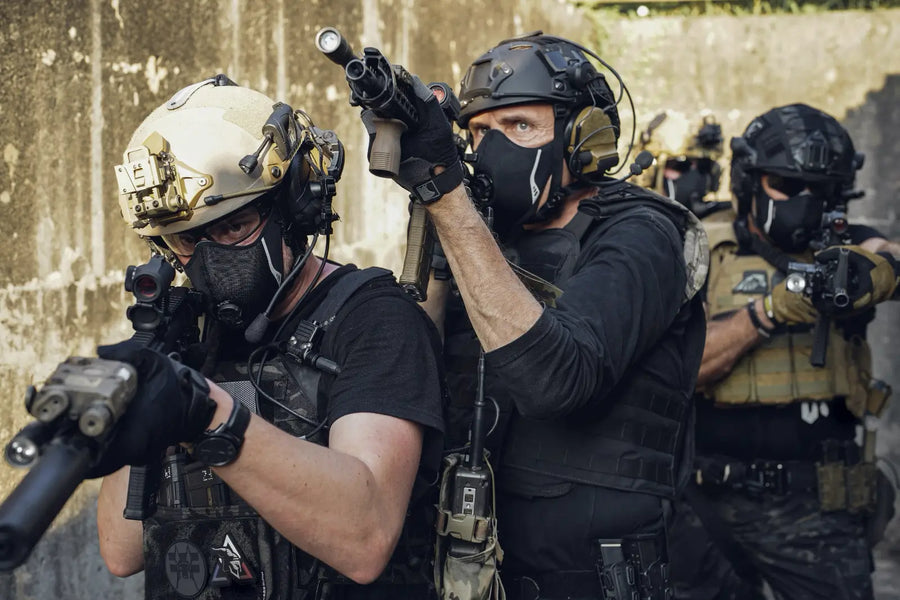
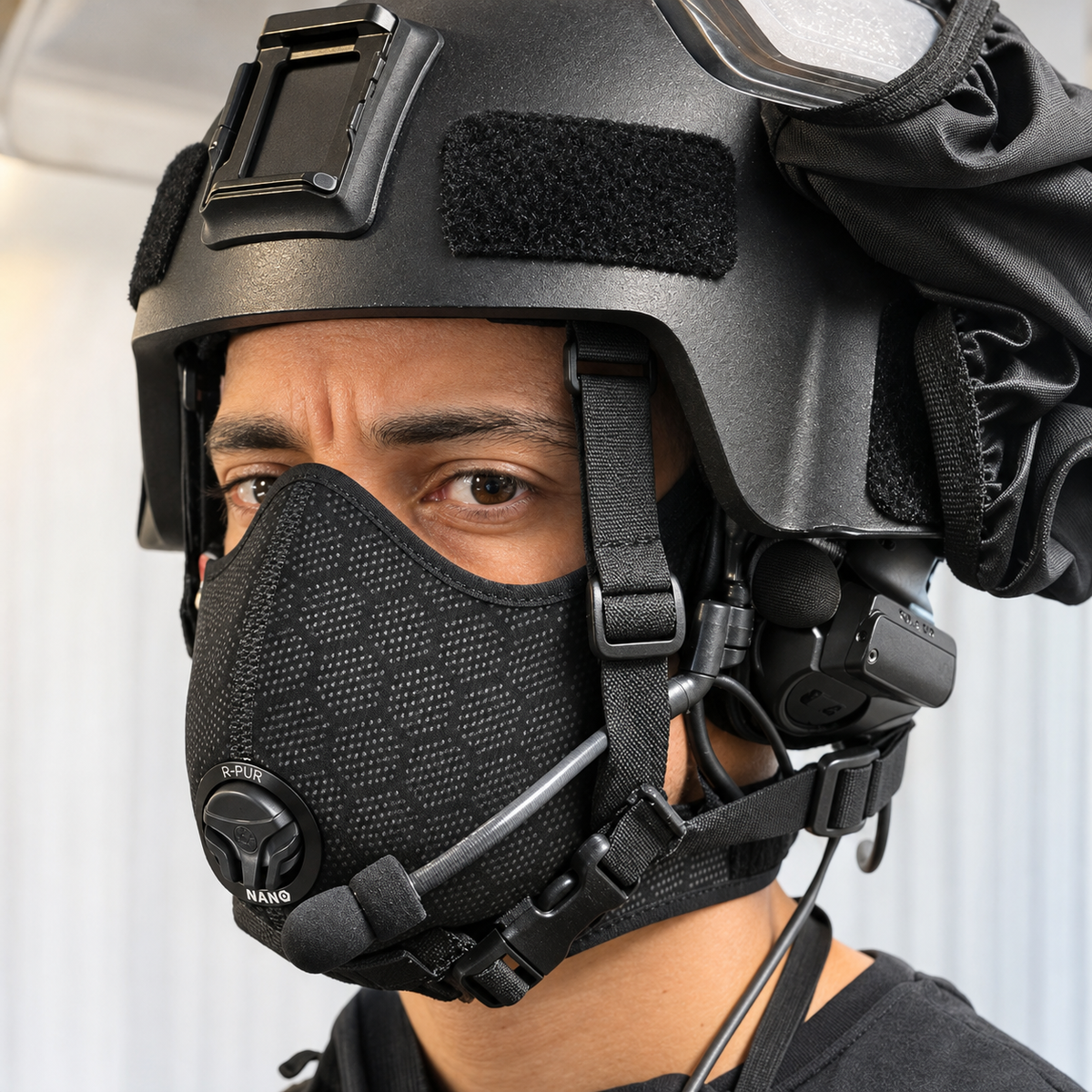
The NANO® Range Mask is one option built for this environment. It filters particles down to 50 nanometers (PM0.05) at N100/FFP3-level filtration, adds an activated carbon layer that reduces gunpowder gases and odors, and takes replaceable filters. To compare types before you choose, read our guide to choosing a respirator for the range.
What does not work:
- Surgical and cloth masks: no particle rating, no seal, no gas filtration.
- N95 respirators: rated for 95% of particles, below the P100 minimum, and nothing for combustion gases.
- Basic dust masks: inadequate for lead aerosols.
A mask reduces what you breathe in. It does not replace range ventilation or hygiene, and if you work at a range, it does not replace your employer's respiratory protection program.
Habits that stack with it
- Put your respirator on before you enter the range, every session.
- Never eat, drink or touch your face at the range or before washing up.
- Wash your hands and face thoroughly with cold water right after shooting.
- Change clothes before leaving, or at least bag your range clothes separately.
- Shower before contact with children or a pregnant partner.
For the full routine, see our decontamination protocol for after the range.
FAQ
Does lead-free ammo eliminate lead exposure at an indoor range?
No. Many lead-free bullets are still loaded over lead-containing primers, and settled lead dust from previous use stays in the room either way. Lead-free ammo reduces your own contribution to airborne lead. It does not clean the range.
How long before lead exposure becomes a problem?
There is no safe threshold. Studies show that regular shooters, including recreational ones, frequently have blood lead levels above 5 µg/dL. Neurological and cardiovascular effects can develop over months to years of repeated exposure, often without obvious early symptoms. If you shoot regularly, ask your doctor whether a blood lead test makes sense for you.
How often should I replace my mask filters?
Replace a particulate filter when breathing resistance increases noticeably, and a carbon filter when you notice odors breaking through, which is a sign the carbon is saturated. Follow the manufacturer's schedule for your model, and never use a disposable mask past its rated lifespan.
If you want a reusable mask built for the firing line, with fine particle filtration and a carbon layer for gunpowder gases, take a look at the Nano Range.
Sources
- OSHA: Lead in Indoor Firing Ranges (OSHA 3772)
- NIOSH: Health Hazard Evaluation, Indoor Firing Range (2016)
- Systematic review of blood lead levels in shooters (2017), PMC
- Airborne lead and particle exposure at indoor ranges (2022), PMC
- Firearms particulate emissions study
- NC DHHS: Preventing Lead Exposure at Indoor Shooting Ranges (fact sheet)
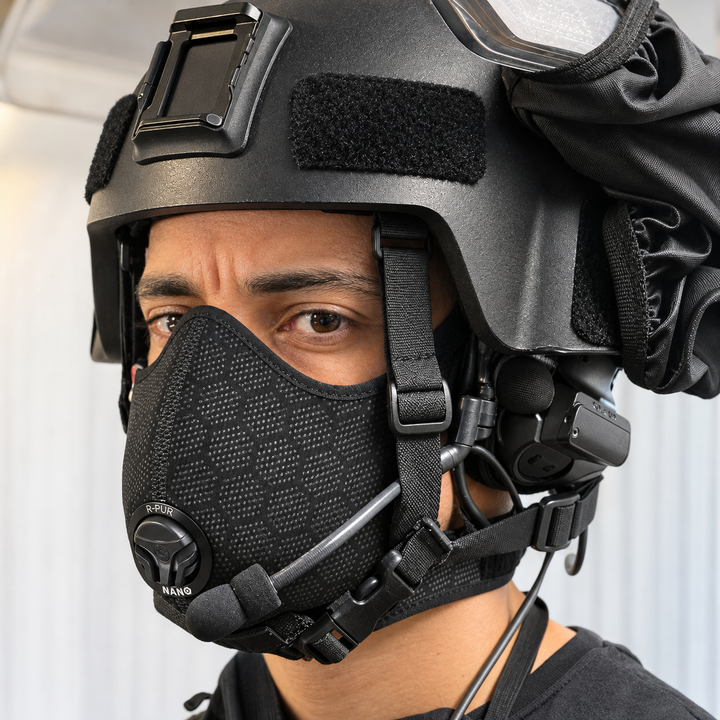
NANO® Range Mask
The shooting mask that filters particles down to 50 nanometers.
From $179 $199
This article is general information for shooters, not medical advice. If you think you have been exposed to lead, talk to your doctor.
Keep reading


Built for the firing line
NANO® Range Mask
Filters particles down to 50 nanometers, with an activated carbon layer for gunpowder gases and replaceable filters.
From $179 $199
