
Lead dust mask: what actually filters lead particles

A lead dust mask only does its job if the filter class is high enough for the fine particles a primer produces, and if the mask seals to your face. Most of the airborne lead at a firing line is smaller than one micron, so the number printed on a disposable mask tells you less than you might think. This guide covers the particle sizes, the filter classes that handle them, and where protection is usually lost.
Key takeaways
- Lead particles at the firing line run from roughly 20 nanometers to 100 microns, with most of the airborne mass below 1 micron.
- An N95 is certified at 0.3 microns and passes at 95%. That is a floor, not a guarantee.
- For lead, the filter classes that matter are N100, R100 and P100 (99.97%) and FFP3 (≥99%).
- The seal usually fails before the filter does. Facial hair in the sealing zone can increase leakage 50 to 1,000 times.
- A mask reduces what you breathe in. It does not replace range ventilation or hygiene.
What lead dust actually is
Two sources of lead meet at a firing line.
Primer lead. Most centerfire primers use lead styphnate as the initiator. When the firing pin strikes, it detonates in a fraction of a millisecond at temperatures above 2,000 °C (about 3,600 °F). The lead vaporizes, then condenses into extremely fine particles. This is a metal fume, not a powder. Winchester's safety data sheet for lead styphnate flags the dust and fume as harmful if inhaled.
Bullet lead. The barrel shaves the base of the bullet, and the projectile fragments on the backstop. That material is coarser, but the impact plume throws a lot of it back into the breathing zone as respirable dust.
Exposure spikes at three moments: primer ignition, right in front of your face; bullet impact on the backstop, which puts settled lead back into the air across the bay; and sweeping, brass pickup and cleaning, which lift dust that has already landed.
Why particle size matters
Classic firing range measurements put airborne lead particles from about 0.02 microns to 100 microns, with the average size falling as you move away from the muzzle. More recent work found lead concentrated in the 0.1 to 2 micron band. One study reported a broad peak from 100 to 8,000 nanometers, a maximum near 1 micron, and a tail reaching down to about 1 nanometer, with roughly 15% of the lead mass in the nano range.
Anything under about 2 microns is respirable: it reaches the alveolar region of the lung instead of stopping in your nose and throat.
A CDC/NIOSH health hazard evaluation of an indoor range found airborne lead and a recreational shooter with a blood lead level of 12.9 µg/dL. Studies of recreational shooters at indoor ranges routinely report mean levels between 7.6 and 24.3 µg/dL. For scale, CDC lowered its childhood blood lead reference value to 3.5 µg/dL on October 28, 2021, and that is a reference value, not a safe level. If you shoot indoors regularly, ask your doctor whether a blood lead test makes sense.
Why an N95 falls short for lead
Under NIOSH 42 CFR Part 84, an N95 must capture at least 95% of particles at the most penetrating particle size, around 0.3 microns. Two points get misread:
- 0.3 microns is the hardest size to filter, not a cutoff. Filters get more efficient for both larger and smaller particles. The smaller ones are captured by diffusion.
- 95% is a pass mark, not a target for lead. It lets 5 particles in every 100 through at the worst-case size, and lead has no known exposure threshold below which it is harmless.
An N95 will catch a real share of coarse lead dust. It is not the right tool for a metal fume that peaks below one micron. Certification also tests the filter media on a rig, not on your face, so it says nothing about the seal against your jaw, cheeks and nose.
Which filter classes stop lead particles
| Filter class | Standard | Rated efficiency | Test particle |
|---|---|---|---|
| N95 / KN95 | NIOSH 42 CFR 84 / GB 2626 | ≥95% | About 0.3 µm |
| N100 / R100 / P100 | NIOSH 42 CFR 84 | 99.97% | About 0.3 µm |
| FFP3 | EN 149 | ≥99%, with ≤2% total inward leakage | 0.3 to 0.6 µm |
For lead, the practical shortlist is N100, R100, P100 and FFP3. In the NIOSH classes the letter is about oil resistance: N is not oil resistant, R is somewhat, P is strongly. Lead dust itself is not oily, but reloading and gun cleaning involve lubricants, so P100 is the safer default if one filter will serve for both.
OSHA's lead standard, 29 CFR 1910.1025, requires HEPA-grade filters on the air-purifying respirators used under the rule, and a full facepiece instead of a half mask when lead aerosols irritate the eyes or skin. NIOSH's indoor firing range guidance for cleaning tasks points to N100, R100 or P100, escalating to supplied air for the highest-exposure jobs. If you work at a range, your employer's respiratory protection program decides what you wear.
Below 0.3 microns
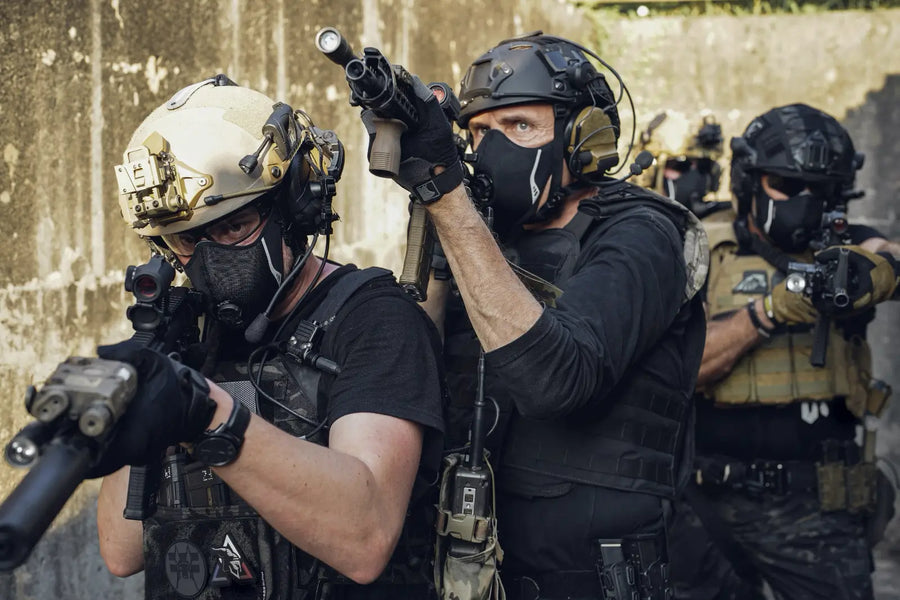
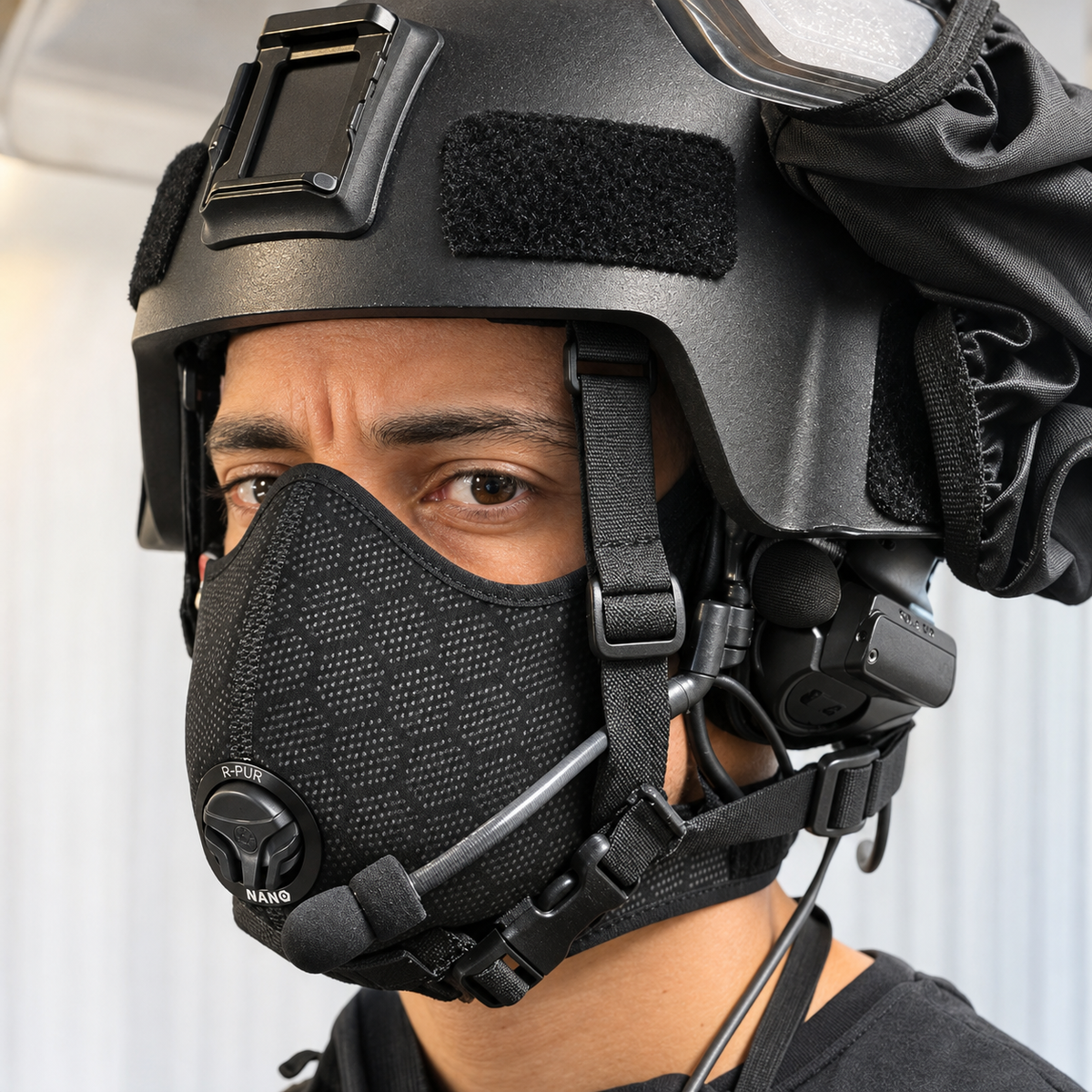
Every class in the table is certified at 0.3 microns or above, while primer lead reaches well below that. Some manufacturers now build nanofiber filter media specified at smaller sizes. The NANO® Range Mask is one example: its internationally patented nanofiltration filters particles down to 50 nanometers (PM0.05), with FFP3-certified filtration (the highest European class, equivalent to NIOSH N100), replaceable filters, and an activated carbon layer that reduces gunpowder gases and odors. That is a statement about the filter, not about fit, which is the next problem.
Face seal: where protection is lost
You can buy the best filter in the table and still get a fraction of its protection, because lead also enters through the gap between the mask and your skin.
Beards
The classic fit-test study of 370 male employees found that half-mask respirators achieved a median fit factor of 12 on bearded wearers, versus 2,950 on clean-shaven ones. Full facepieces managed 30 versus better than 10,000. NIOSH summarizes controlled studies as showing that facial hair typically increases leakage by 50 to 1,000 times. One study found performance deteriorated once hair exceeded roughly 1/8 inch (3 mm) in the seal zone. A tight-fitting mask only works on a clean-shaven seal zone.
Cheek weld
Pressing your cheek onto a rifle stock loads one side of the mask, the same surface that carries the seal. Standard fit-test protocols include head movements and talking, not sustained side pressure from a stock. If you shoot prone for long strings, look for a wide, compliant sealing surface, check the seal yourself in position, and re-seat the mask after every string.
For mask formats and fit with eye and ear protection, see our guide to choosing a respirator for the range.
Lead dust away from the firing line
Many shooters buy a mask for the range, then handle the worst contamination at home. Primer residue clings to spent cases, and a vibratory tumbler is essentially a dust generator. Empty it outdoors or under extraction, wear a P100 while you do it, and never dry-sweep the bench (more in our article on lead exposure when reloading).
Lead also rides home on hands, clothes, shoes, bags and brass. EPA and HUD cleanup guidance is consistent: HEPA vacuum, wet wipe or wet mop, then HEPA vacuum again once surfaces are dry. The full routine is in our guide to decontamination after the range.
At the range, wear the mask for cleanup and brass pickup too. That is when airborne concentrations are highest.
FAQ
Does an N95 protect against lead dust?
Partially. It collects some lead dust, but 5% of particles at the test size pass through, and that sub-micron band is where lead aerosol is concentrated. For lead, use N100 or P100 (99.97%) or FFP3 (≥99%).
Will a P100 stop lead dust?
It is the correct class, and it is what OSHA's lead standard and NIOSH's range-cleaning guidance point to. On a leaking facepiece it delivers a fraction of its rating. Seal first, filter class second.
How often should I replace the filter?
There is no clock-based answer in lead work. Replace it when breathing resistance rises noticeably, when it is visibly loaded or damaged, and whenever the manufacturer's schedule says so. Write the install date on the filter.
If you want a reusable mask made for shooters, with replaceable filters, the Nano Range is one option.
Sources
- OSHA: 29 CFR 1910.1025, Lead
- NIOSH NPPTL: Respirator Filter Classes
- CDC NIOSH: Beards and Respirators (2024)
- CDC: Updated Blood Lead Reference Value
- CDC NIOSH: Health Hazard Evaluation 2018-0124-3351 (indoor firing range)
- CDC NIOSH: Indoor Firing Ranges bulletin (2009)
- OSHA: Lead in Shooting Ranges (OSHA 3772)
- EPA: Reduce your risk of lead exposure in the home
- Study: airborne lead particle size at indoor firing ranges
- Review: blood lead levels among recreational shooters
- Public Health Ontario: Lead exposure among shooters (2014)
- Winchester: Lead styphnate primer safety data sheet
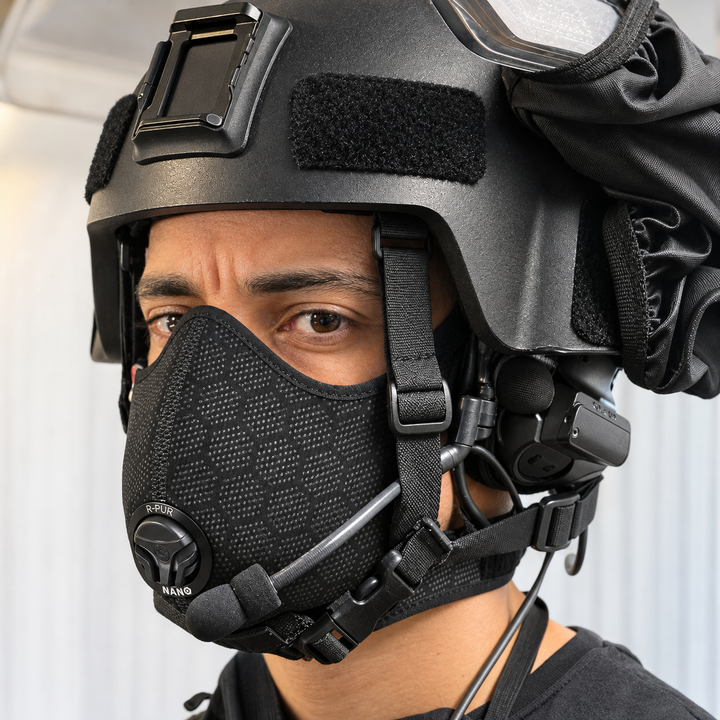
NANO® Range Mask
The shooting mask that filters particles down to 50 nanometers.
From $179 $199
This article is general information for shooters, not medical advice. If you think you have been exposed to lead, talk to your doctor.
Keep reading


Built for the firing line
NANO® Range Mask
Filters particles down to 50 nanometers, with an activated carbon layer for gunpowder gases and replaceable filters.
From $179 $199
