
Shooting range mask: what to wear and how to choose

A shooting range mask has one job: keep the lead and powder residue in range air out of your lungs. The right one filters at the 99% level or better, seals on your face, and fits with your eye and ear protection so that you keep it on. This guide compares the kinds of mask shooters actually wear and lists what to check before you buy one.
Key takeaways
- A mask is worth wearing at any indoor range. Most primers contain lead, and every shot puts fine lead particles into the air you breathe.
- An N95 helps, but it is below the level NIOSH lists for lead. For regular range use, look for N100 or P100, or FFP3 on European masks.
- There are four practical formats: disposable masks, half-face cartridge respirators, reusable filtering masks made for shooting, and full-face masks.
- Fit decides the result. A mask that leaks at the nose, clashes with your ear muffs or lifts off the stock will not be worn properly.
- No mask filter removes carbon monoxide, and no mask replaces washing your hands after the range.
Do you need a mask at the shooting range?
Most standard primers use lead styphnate. When the primer fires, that lead turns into very fine particles that hang in the air, and bullets with exposed lead add more. CDC and NIOSH investigations of indoor ranges have repeatedly measured airborne lead above occupational limits, mainly where ventilation was poor or the shooting volume was high. Our article on indoor range air quality goes through what is in that air.
Lead builds up in the body over time, and according to the CDC there is no safe blood lead level. That is why the shooters who gain most from a mask are the ones with the most range time: frequent indoor shooters, competitors, instructors and range safety officers. It also matters if you have children at home, because what you breathe in is only part of the picture and what you carry home is the rest.
Outdoors the air clears faster and the risk is lower, but it is not zero. Wind can push smoke back along the line, and steel targets and berms hold lead dust.
Does an N95 protect against lead dust?
Partly. An N95 filters at least 95% of test particles and is far better than nothing. It falls short for range use in three ways:
- The rating. For lead, the NIOSH Pocket Guide lists respirators with N100, R100 or P100 filters. An N95 is a class below that.
- Oil. The N stands for "not resistant to oil". Powder residue and gun lubricants put oily aerosols in the air, which can degrade N-series filter material.
- The seal. A disposable cup held by two thin elastics leaks easily at the nose and cheeks, more so under ear muffs and against a stock.
If an N95 is all you have for a single visit, wear it and press the nose clip down properly. If you shoot indoors regularly, step up.
The kinds of shooting mask
| Type | Filtration | Strengths | Limits |
|---|---|---|---|
| Disposable N95 | ≥95% | Cheap, light, sold everywhere | Below the level listed for lead, seal varies, single use |
| Disposable N100 or P100 | ≥99.97% | The right filter level at a low price | Stiffer and warmer, single use, tends to fog glasses |
| Half-face respirator with P100 cartridges | ≥99.97% | Strong seal, NIOSH-approved models, replaceable cartridges | Side cartridges can get in the way of a rifle or shotgun stock, heavier, industrial look |
| Reusable filtering mask made for shooting | Check the stated class (N99, N100 or FFP3) | Low profile under muffs and against the stock, replaceable filters, comfortable over a long session | Check which standard it was tested to and that it comes in your size |
| Full-face mask | ≥99.97% with P100 filters | Covers the eyes, highest protection factor | Heavy, fogs, awkward with ear muffs and a cheek weld, expensive |
Any mask for the shooting range is one of these. For most recreational and competitive shooters the choice is between a half-face cartridge respirator and a reusable shooting mask. Our respirator guide compares half-face and full-face in detail.
Shooting mask or shooting respirator?
Shooting mask, shooting respirator, face mask for shooting: in everyday speech they are the same thing. In US regulation, a respirator is a device certified by NIOSH, with classes such as N95, N100 and P100. Europe uses FFP classes under its own standard, and FFP3, the highest, requires at least 99% filtration.
The difference matters in one case. A range is a workplace for its staff, and OSHA requires employers to supply NIOSH-approved respirators as part of a respiratory protection program. Recreational shooters are free to choose, so read the label: which class the mask claims and which standard it was tested to. Be wary of masks that only say "tactical" or "military grade".
What to check before you buy
- Filter level. 99% or better, with a stated class. N100 and P100 are the top US classes, and FFP3 is the top European one.
- Seal and sizes. An adjustable nose bridge, straps that hold when you turn your head, and more than one size. A beard along the seal line breaks the seal on any mask.
- Ear muffs and glasses. Straps should pass above and below the muff cups without lifting them. The top edge should not push your shooting glasses up. An exhalation valve sends warm air down and away from the lenses, which cuts fogging.
- Cheek weld. If you shoot rifle or shotgun, the side of the mask has to be slim enough to let your cheek reach the stock.
- Breathing. Low resistance on the inhale and a valve on the exhale. A mask that feels stuffy ends up around your neck.
- Filters. Replaceable, easy to buy, and priced so that you will change them on time.
- Gases and smell. An activated carbon layer reduces powder smell and some gases. It does not remove carbon monoxide.
Where the Nano Range fits
The NANO® Range Mask is the reusable kind. It filters particles down to 50 nanometers (PM0.05), offers FFP3-certified filtration (the highest European class, equivalent to NIOSH N100) through internationally patented nanofiltration, has an activated carbon layer that reduces gunpowder gases and odors, and takes replaceable filters. Hold it to the same checklist as any other mask, starting with fit.
Wearing it right
- Put the mask on before you walk onto the range, not at the lane.
- Check the seal: breathe in sharply and feel for air coming in at the nose and cheeks, then adjust.
- Keep it on between strings. Fine particles stay in the air after the shooting stops.
- Take it off after you have left the range, with clean hands, and store it in its own bag.
- Change the filter when breathing gets harder, when it is damaged or wet, or on the maker's schedule.
What a mask will not do
- Carbon monoxide. Burning powder produces carbon monoxide, and particle filters and activated carbon do not stop it. Only ventilation does. A headache or dizziness indoors means step outside. See headache after shooting.
- Hands and clothes. Lead on your skin, clothes and gear goes home with you. Wash hands and face before you eat or drive, and follow our decontamination routine.
- Noise. A mask is not hearing protection. Wear plugs and muffs together indoors.
FAQ
Do I need a gun range mask at an outdoor range?
The need is lower than indoors. It is still worth wearing if you shoot outdoors often, shoot steel at close range, or stand on a busy line where smoke drifts back at you.
Can I wear a shooting mask with a beard?
You can wear it, but a beard along the seal line lets unfiltered air in. Stubble has the same effect to a smaller degree. A clean seal line gives the mask its rated performance.
How often should I change the filter?
There is no single number of hours. Change it when breathing resistance rises, when the filter is damaged, wet or dirty, or when the manufacturer's schedule says so. Heavy indoor shooting uses filters up faster.
Is a surgical or cloth face mask any use at the range?
Very little. Both fit loosely and neither is built to filter fine particles, so most of the air goes around or through them.
If a reusable mask with replaceable filters suits the way you shoot, the Nano Range is one option to look at.
Sources
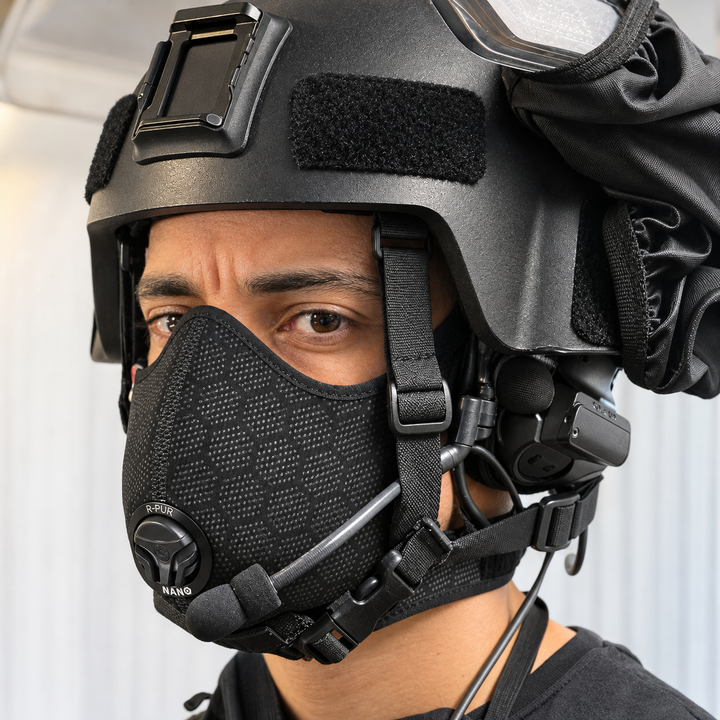
NANO® Range Mask
The shooting mask that filters particles down to 50 nanometers.
From $179 $199
This article is general information for shooters, not medical advice. If you think you have been exposed to lead, talk to your doctor.
Keep reading


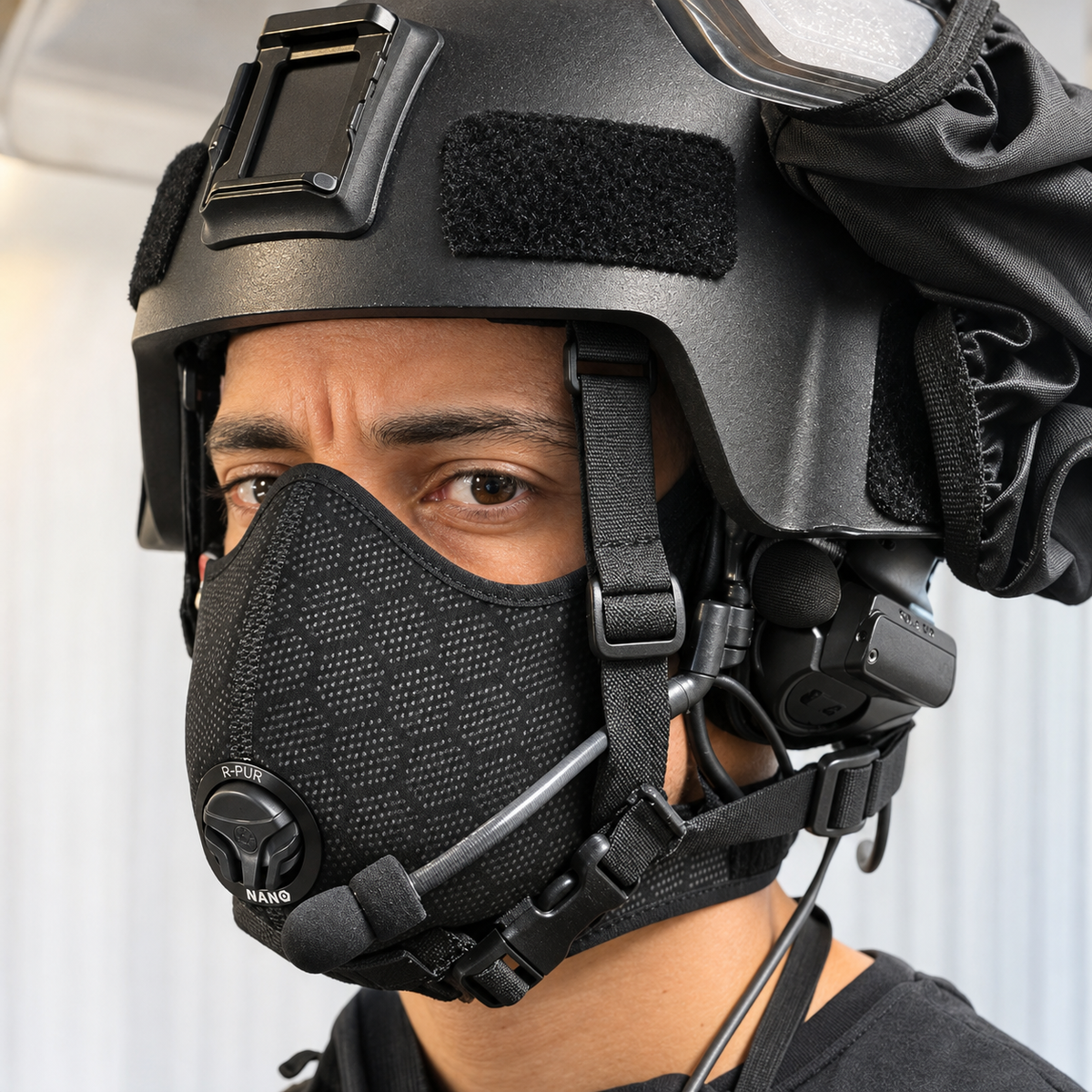
Built for the firing line
NANO® Range Mask
Filters particles down to 50 nanometers, with an activated carbon layer for gunpowder gases and replaceable filters.
From $179 $199
